

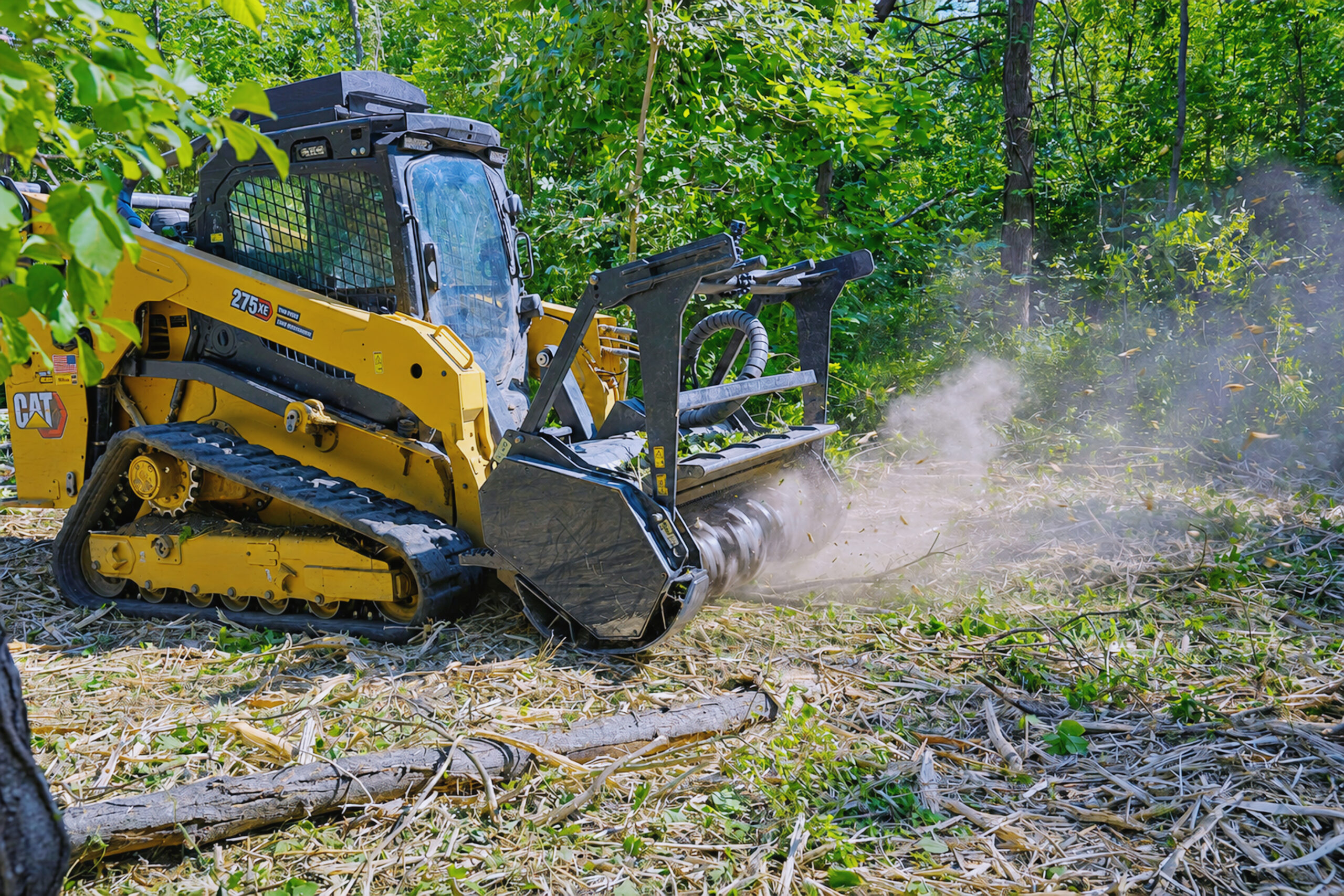
Most people think of land clearing as a spring and summer job. In Western New York, some of the best clearing days of the year actually happen in January. Once the ground freezes, a tracked mulcher can move across wet fields, wooded lots, and overgrown pasture that would be too soft to work in April, and it leaves the soil underneath in great shape.
If you’re planning to build, reclaim a field, or open up trails next year, winter forestry mulching is one of the smartest ways to get a head start. Below, we’ll cover how forestry mulching works, why winter is such a good fit around Rochester and Geneseo, the conditions that make it work best, and what your land can be ready for by spring.
What Is Forestry Mulching?
Forestry mulching is a land-clearing method in which a machine cuts standing trees, brush, and undergrowth, then grinds them into mulch in a single pass. The mulch stays on the ground as a protective layer, so there’s no burning, no brush piles, and no trucks hauling debris off site.
We run tracked mulchers sized for the job, from small residential lots to parcels of 50 acres or more. Because the mulching head cuts and grinds simultaneously, you also get to choose what stays. Healthy hardwoods, a shade tree near the house, or a row of evergreens along the property line can all be left standing while everything around them gets cleared.
Why Winter Is a Great Time for Forestry Mulching in Western NY
Winter is a great time for forestry mulching in Western NY because frozen ground supports heavy equipment, bare trees make planning easier, and clearing done now leaves your land ready to use the moment spring arrives. Here’s how the seasons compare.
| Winter (December to March) | Spring and Summer | |
|---|---|---|
| Ground conditions | Frozen and firm, with very little rutting | Often soft after the thaw and spring rain |
| Visibility | Leaves are down, so trees, stumps, and grades are easy to see | Full foliage can hide terrain, rocks, and old fencing |
| Cutting oak trees | Falls in the October to February window NYS DEC recommends | April through July is the high-risk period for oak wilt |
| Project timing | Land is cleared and ready when build and planting season starts | Clearing happens during the build and planting season |
Frozen ground is the biggest advantage. Tracked machines already spread their weight well, and once the top few inches lock up, a mulcher can cross low spots and wet areas without churning up the soil. That means less grading and cleanup later.
Bare trees help too. Without leaves, it’s much easier to see the shape of the land, mark the trees you want to keep, and spot rock piles or drainage paths before the machine gets there. And if your property has oaks, winter is the right time to cut them. The New York State Department of Environmental Conservation recommends cutting or pruning oaks from October through February, when the insects that spread oak wilt aren’t active.
What Conditions Make Winter Mulching Work Best?
The best conditions for winter forestry mulching are a solid frost in the ground, light snow cover, and a steady stretch of cold weather. Here’s what we look for before scheduling a job:
- Ground frozen several inches deep, which usually takes a week or more of below-freezing temperatures
- Snow light enough that stumps, rocks, and grade changes are still visible
- Clear or overcast days without freezing rain, so the machine and operator can work safely
- Access points that let equipment reach the work area without crossing soft ground
Heavy snow is the one thing that shifts the plan. A deep blanket of snow insulates the soil and can keep it from freezing, so after a big lake effect storm we’ll often let things settle first. Thaws happen too. When temperatures climb, we move to better-drained sections of the property or pick back up once the ground firms again. Planning around Western NY weather is just part of doing winter clearing well.
What Can Your Land Be Ready For by Spring?
Clearing in winter puts you ahead of the season. These are some of the most common projects landowners line up once the mulching is done:
- Home sites and building pads ready for grading and site prep
- Overgrown fields reclaimed for pasture, hay, or crops
- Walking, hunting, and ATV trails through wooded acreage
- Open ground for a new farm or recreational pond
- Clear routes for driveways and farm access roads
Since we also handle site preparation, pond construction, road building, and trail mulching, the next phase of your project can start as soon as conditions allow, without bringing in another contractor.
Want Your Land Cleared and Ready by Spring?
Picture walking your property in April and seeing open ground where the brush used to be. The trees you wanted to keep are still standing, a layer of mulch is protecting the soil, and the site is ready for whatever comes next, whether that’s a foundation, a pasture, or a pond.
That’s what Excavation Services by Justin Koschara delivers. We walk the property with you, flag what stays, time the work around frost and weather, and clear it with forestry mulching equipment sized for your acreage, whether that’s a few acres in Henrietta or a large parcel near Geneseo.
Call (585) 549-3663 or message us to schedule a free estimate. You’ll talk directly with the person running the machine, and you’ll walk away with a clear plan and timeline for getting your land cleared this winter.
FAQ Section
How much does forestry mulching cost in Western NY?
Forestry mulching is usually priced by the acre or by the day. The final cost depends on vegetation density, tree size, terrain, and how easy the site is to reach. A lightly overgrown field typically costs less per acre than a thick stand of young trees, so the most accurate number comes from a free on-site estimate.
How long does it take to forestry mulch an acre?
It depends mostly on density. An acre of light brush and saplings can often be cleared in a few hours, while heavily wooded ground with larger trees can take a full day or more. You’ll get a timeline for your specific property along with your estimate.
Do I need a permit to clear land in New York?
Many residential and agricultural clearing projects don’t need a permit, but some do. Wetlands, land near streams, and certain development projects can fall under NYS DEC or local town rules. It’s a good idea to check with your town’s building or zoning office before work starts, and we’re happy to talk through what your project might involve.
Can I build or plant on land after it’s been mulched?
Yes. Grass and native plants often grow back through a typical mulch layer within a season or two, which helps hold the soil in place. If you’re building, the mulch can be pushed aside or worked in during grading, so it won’t get in the way of a foundation or driveway.